Eastern subterranean termites cause continuous structural damage across Middle Tennessee due to heavy annual rainfall exceeding 47 inches and rich, loamy soils that maintain high moisture reserves. Neighborhoods with…
Eastern subterranean termites cause continuous structural damage across Middle Tennessee due to heavy annual rainfall exceeding 47 inches and rich, loamy soils that maintain high moisture reserves. Neighborhoods with dense hardwood canopies and historic architecture, such as 1920s craftsman bungalows in Belmont-Hillsboro, historic brick foundations in Germantown, and pier-and-beam cottages in East Nashville and Inglewood, exhibit high baseline vulnerability. The subterranean species lives in underground colonies housing up to 1,000,000 individual insects, building subterranean mud tubes upward across poured concrete stem walls, brick mortar, and damp plumbing penetrations to consume structural wood components. Left unchecked, colonies hollow out sill plates, subfloors, and load-bearing studs, operating completely concealed behind interior drywall.
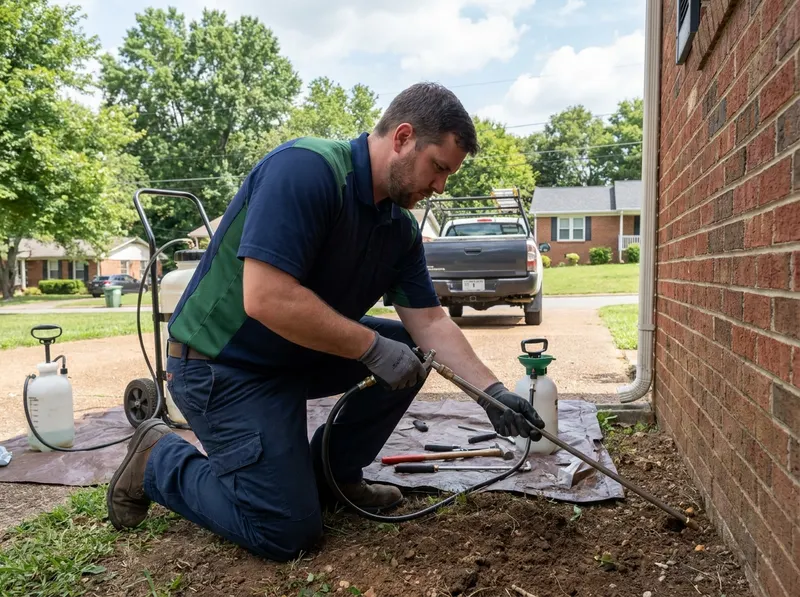
Effective defense requires an uninterrupted chemical or physical envelope. Liquid barrier applications rely on non-repellent termiticides such as EPA-approved termiticides like fipronil or imidacloprid, regulated closely under the Tennessee Department of Agriculture Pesticide Division. Because workers cannot detect non-repellent formulations, they travel through treated soil zones, ingesting the product and transferring it throughout the nest via social grooming until colony collapse occurs. MapleDrift Extermination excavates continuous six-inch trenches along external foundation perimeter walls, saturating the soil backfill at 4 gallons per 10 linear feet. For structures built over continuous concrete pads, such as modern infill developments in The Nations or renovated commercial layouts near Centennial Park, technicians drill vertical 1/2-inch ports through concrete slabs every 12 inches to inject barrier products directly beneath the grade.
Homeowners selecting defense strategies must evaluate perimeter trenching against slow-acting baiting systems. Continuous liquid soil treatments create an immediate lethal perimeter that halts ingress within days, representing an ideal protocol when active mud tubes are found inside living quarters. In contrast, baiting stations require foraging workers to stumble upon bait wood over multiple months, increasing the risk of interim structural loss. Soil chemistry testing via the University of Tennessee Extension highlights how dense clay in Crieve Hall and Donelson can limit liquid migration if not applied using high-pressure mechanical rods. In sensitive residential settings, modern subterranean termiticides bond tightly with soil particles to minimize leaching, meeting standards set forth by the Agriculture and Agri-Food Canada Pest Management Regulatory Agency and the California Department of Pesticide Regulation, while remaining undetectable to non-target mammals once dry under guidance from the National Institute for Occupational Safety and Health.
Structural protection follows a clear four-step process. First, technicians perform an exhaustive tactile inspection of crawlspaces, basement rim joists, and floor supports, adhering to safety frameworks from the Occupational Safety and Health Administration. Second, exterior soil lines receive continuous trenching and high-pressure rod applications down to the footing depth. Third, expansion gaps, porches, and abutting walkways are drill-treated and sealed using non-shrinking masonry plugs. Fourth, property owners receive a digital structural map detailing moisture entry points, crawlspace relative humidity readings, and physical clearance distances, fulfilling recommendations outlined by the U.S. Department of Housing and Urban Development and building safety standards from the International Code Council.
Every job gets a firm, written price after a free on-site visit.
Tell us about your subterranean termite treatment job in Nashville and we'll send a clear, written quote, usually the same day.
 MapleDrift Extermination